



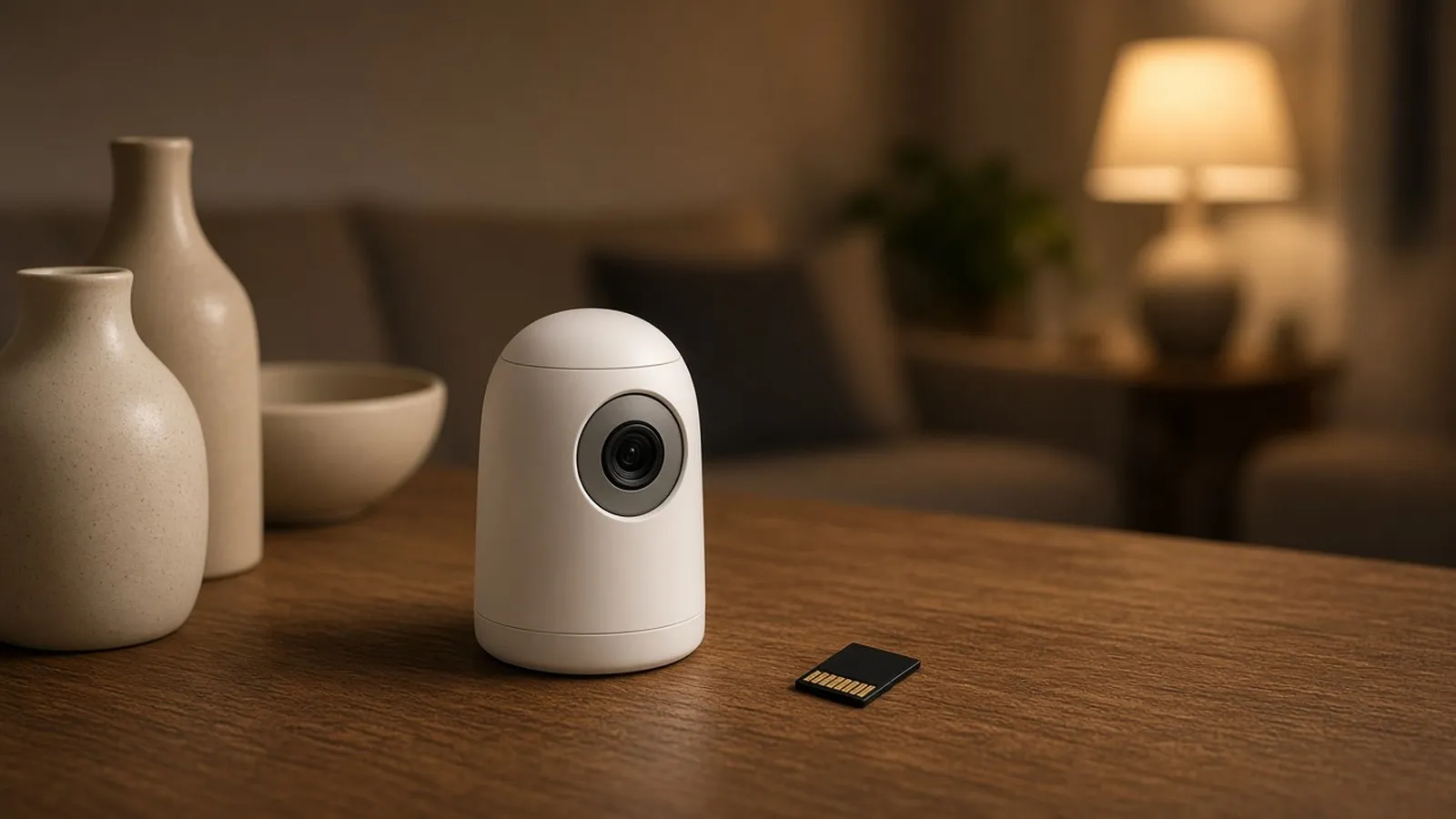
This whole guide is written from Copilot.cx's point of view: we help brands run cloud subscriptions, and we say so up front. The comparison and the official records below are meant to be fair to every option, including the ones we don't recommend. Official records are cited as of Oct 16, 2026.
SD card vs cloud storage for security cameras: comparison table
| SD card only | Cloud only | Hybrid (SD plus cloud) | |
|---|---|---|---|
| If the camera is stolen | Footage stored on the card can leave with the camera | Footage already uploaded stays in the account for the plan's retention period | Uploaded footage stays; the local copy may not |
| Privacy | Footage stays on the device unless the owner moves it | Footage sits on the brand's servers, so the brand's access controls matter | Both sets of considerations apply |
| Offline use | Depends on the product's design; check the vendor's documentation | Depends on the product's design; check the vendor's documentation | Depends on the product's design; check the vendor's documentation |
| Bandwidth | Little or no upload for storage | Uploads recordings over the home connection | Uploads some or all recordings |
| Cost to consumer | The card, once | A recurring fee, if the plan is paid | The card plus any plan fee |
| Revenue to brand | Hardware sale only | Recurring subscription revenue possible | Recurring revenue possible, with a local option |
The table describes how the models are built. It does not quote theft, outage or bandwidth statistics, because we could not find official sources for them.
Q: Is cloud storage or an SD card better for a security camera?
Neither is better for everyone: an SD card keeps footage on the device with no recurring fee, cloud storage keeps a copy off the camera so it survives theft or damage, and a hybrid setup offers both at the cost of a card plus any subscription, so the right choice depends on what the owner worries about most.
For a camera brand, the question has a second half: which model can you support well for the life of the product? Each one needs a clear setup flow, plain language about where footage lives, and honest pricing.
When local storage makes sense
Local storage deserves a fair hearing. It suits owners who don't want footage leaving the home, owners who don't want a monthly bill, and places where the internet connection is slow or capped. For a brand, an SD slot can also appeal to buyers who want footage kept at home. If a brand offers both, it should be clear in the box and in the app which features depend on the cloud and which do not.
Privacy and breaches
This section quotes official records only.
The Federal Trade Commission's case page for Ring, LLC states: "The FTC charged Ring with compromising its customers' privacy by allowing any employee or contractor to access consumers' private videos and by failing to implement basic privacy and security protections, enabling hackers to take control of consumers' accounts, cameras, and videos." (FTC, Ring, LLC case page, as of Oct 16, 2026)
The same page's case timeline lists a June 16, 2023 "Stipulated Order for Injunction and Monetary Judgment" and an April 23, 2024 press release titled "FTC Sends Refunds to Ring Customers Stemming from 2023 Settlement over Charges the Company Failed to Block Employees and Hackers from Accessing Consumer Videos."
Subscription economics
The figures below are from one company's SEC filing. They describe Arlo Technologies, Inc. only and are not industry averages.
In its second quarter 2026 results (quarter ended June 28, 2026), Arlo reported subscriptions and services revenue of $93.0 million, growing 19.0% year over year and accounting for 59.7% of total revenues, and annual recurring revenue of $365.0 million, growing 15.6% year over year. It reported a GAAP subscriptions and services gross margin of 81.1% (Arlo Q2 2026 earnings release, SEC EDGAR, as of Oct 16, 2026).
The same release reports about 13.6 million cumulative registered accounts and 6.3 million cumulative paid accounts at quarter end (13,569 and 6,303, in thousands, in the release's table). By our calculation, paid accounts were about 46% of registered accounts. That ratio is our arithmetic, not a figure Arlo reports. Arlo notes that registered accounts do not directly correspond to the number of users.
Consumer protection
This section quotes official sources only and is not legal advice.
Restore Online Shoppers' Confidence Act (ROSCA). 15 U.S.C. § 8403 states: "It shall be unlawful for any person to charge or attempt to charge any consumer for any goods or services sold in a transaction effected on the Internet through a negative option feature ... unless the person" meets the conditions the section lists, beginning with "text that clearly and conspicuously discloses all material terms of the transaction" (15 U.S.C. § 8403, U.S. Code via govinfo.gov, 2023 edition, as of Oct 16, 2026).
FTC Negative Option Rule, status. A final rule published in the Federal Register on Feb 12, 2026 states that the Commission "is revising its recently amended 'Rule Concerning Recurring Subscriptions and Other Negative Option Programs' ('Negative Option Rule') to recodify the text of the Negative Option Rule as it existed before the effective date of the Commission's 2024 final rule amending it" (Federal Register, 2026-02866, as of Oct 16, 2026).
A later advance notice of proposed rulemaking, published Mar 13, 2026, states that the FTC "seeks public comment on the need for amendments to the Commission's 'Rule Concerning the Use of Prenotification Negative Option Plans'" to help consumers "avoid recurring payments for products and services they did not intend to order and to allow them to cancel such payments without unwarranted obstacles" (Federal Register, 2026-04952, as of Oct 16, 2026).
This guide does not cover state auto-renewal laws; check current official state sources with counsel.
Illustration: how a low monthly price adds up
These numbers are hypothetical and chosen only to show the arithmetic. They are not any brand's prices.
| Hypothetical plan price | 1 year | 3 years | 5 years |
|---|---|---|---|
| $3 a month | $36 | $108 | $180 |
| $5 a month | $60 | $180 | $300 |
| $10 a month | $120 | $360 | $600 |
A small monthly number becomes a real line in a household budget over the life of a camera. That cuts both ways: it is meaningful revenue for a brand, and a reason the plan has to keep earning its place.
Decision checklist
- What does the camera do with no plan at all? Write it down in one sentence and put that sentence on the box.
- Where does footage live, and who can access it? Document employee and contractor access rules before launch.
- Is account security strong by default? The FTC's Ring case page cites a failure "to implement basic privacy and security protections."
- Is the subscription disclosed clearly before checkout? ROSCA's text refers to "text that clearly and conspicuously discloses all material terms of the transaction."
- Is cancelling simple? Show customers where and how to cancel, in the app and on the web.
- Do you offer a local option? If not, explain why in plain language.
Why we favor cloud storage
We favor cameras designed for cloud storage without an SD card, backed by a subscription the customer can see, understand and cancel easily. Our reasons: footage off the device survives the device, a cloud plan lets a brand keep improving the product after the sale, and recurring revenue funds that work. We also think local storage is a legitimate choice for many owners, and a brand that goes cloud-only owes customers strong access controls and honest, simple billing.
What this means for your post-purchase app
The storage model shows up in the app before it shows up anywhere else. The app is where customers learn what the camera does without a plan, see what they are paying for, and manage or cancel a subscription. Copilot.cx's Subscription Engine is the part of our platform built around that stage.
FAQ
Is cloud storage or an SD card better for a security camera?
Neither is better for everyone: an SD card keeps footage on the device with no recurring fee, cloud storage keeps a copy off the camera so it survives theft or damage, and a hybrid setup offers both at the cost of a card plus any subscription, so the right choice depends on what the owner worries about most.